Why do artists stick with a distributor they’re not fully happy with? Switching is easy and the upside for artists big.
“I wish my digital distributor were…”
Cheaper. Better. More reliable. More flexible.
We hear it all the time.
So, why do artists stick with a distributor they’re not fully happy with? We asked a few artists, and one argument kept coming back:
“All my tracks are released through [enter distributor name], I wouldn’t even know where to start with re-distributing. I wouldn’t want to lose my tracks, my streams, my playlist positions.”
We get it.
Distributors can be surprisingly hard to walk away from, and switching, honestly feels intimidating.
Your tracks are your pride and joy. You’ve spent hours, days, months working on them—not to mention the streams you’ve built up. Why risk it all just because your current distributor isn’t that ideal? We’re here to challenge this thinking.
Because switching distributors is easy; and the upside for artists is big.
Why Artists Hesitate to Switch Distributors
Let’s be real. Trying to make it in the music industry isn’t cheap. On top of producing music, artists have to pay to release it, collect royalties, and promote it. If you’re already locked in to a distributor, switching might sound like a lot of effort for very little upside.
But here’s the real differentiator: Most digital distributors focus only on getting your music onto DSPs.
But what if your distributor could do more than just release your tracks?
What if your digital distributor could promote your tracks, protect them, monetize them, and help you share them? Now this changes the conversation from music release to music strategy.
But it’s not just about money. It’s also about your time. Every artist service asks for the same info: Artist details. Proof of artist identity. Track metadata. Track history. Updated releases. Over and over again.
Imagine importing your catalog once, then managing everything from a single place.
One platform. One workflow. One subscription. To release, protect, monetize, promote, and build fan community around your music. With Winamp for Artists, it’s possible. But we get to that later.
For now, let’s take a look how artists can switch distributors. (p.s. It’s a lot easier than it may seem.)
How to Switch Digital Music Distributors
Switching digital music distributors comes down to three simple steps:
#1. Uploading tracks to your new distributor
#2. Releasing tracks under your new distributor
#3. Removing tracks from your old distributor
Let’s take a look at Step 1.
Uploading your tracks to a new distributor.
With Catalog Import, uploading your tracks to a new distributor is easier than ever. All you need is your Spotify Artist URL, which you can find on your Spotify artist profile.
Just click the 3 dots next to your artist name, select “Share” and “Copy link to artist”.
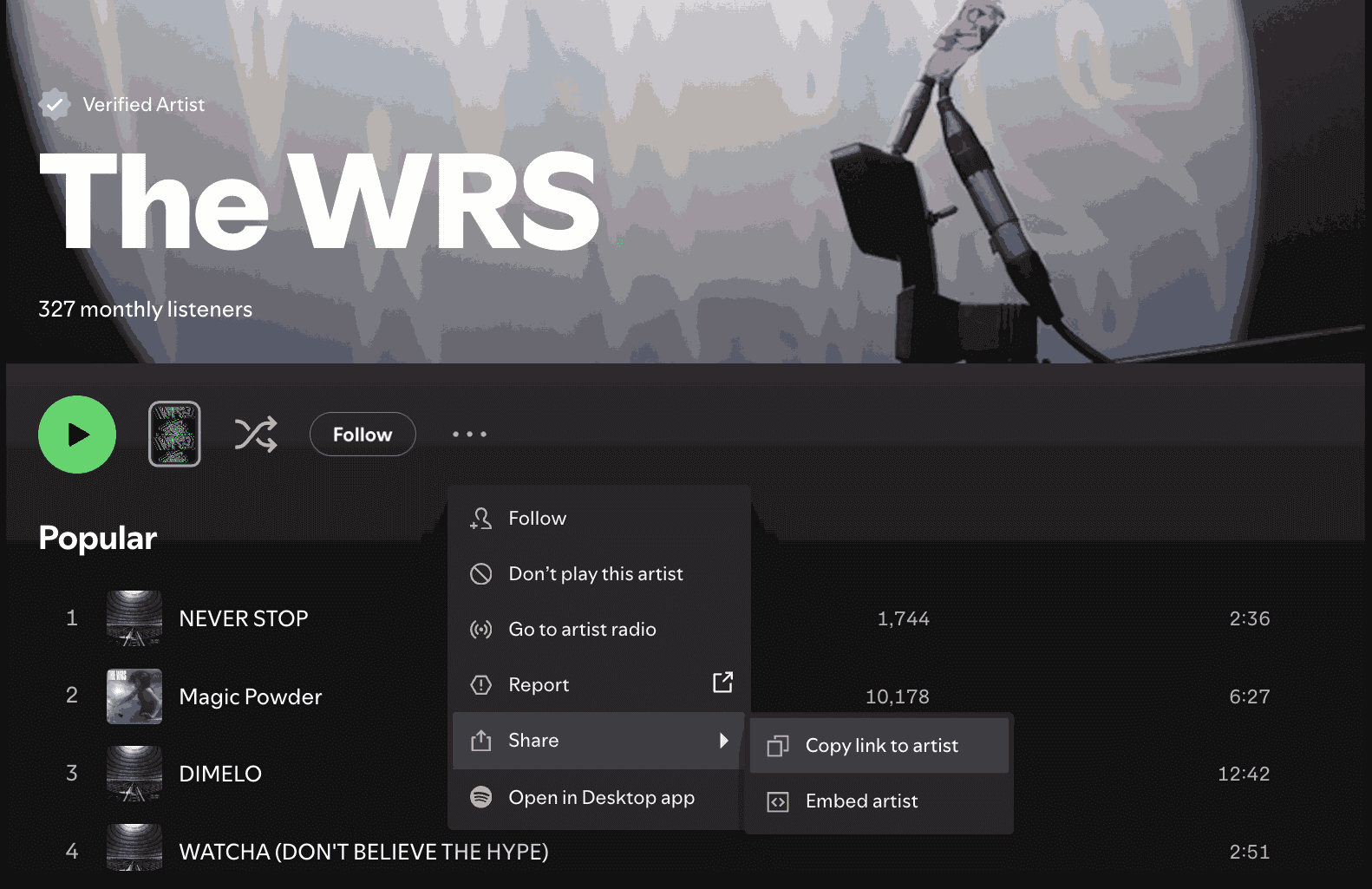
Your artist URL let’s you easily import all your released tracks directly into Winamp for Artists. By doing so, all your track titles, cover art, and ISRC codes automatically transfer over.
This saves you the time and effort needed to individually create a new media file for every track already released.
And once your tracks are imported into the platform, the only things you need to do are:
Adding in original audio files.
Including contributors that contributed to track composition, songwriting or production.
Once your tracks are fully uploaded and correctly filled out, you’re all ready to move on to Step 2.
Releasing tracks under a new distributor.
Now, many artists get confused why they need to release music, before removing their tracks from their current distributor.
This is basically a fail safe mechanism. Releasing a duplicate lets you confirm that Spotify (or another DSP) recognises the re-release as an exact match.
If re-release correctly implemented, you should see 2 identical tracks each with identical stream counts. On Spotify, a duplicate release can be spotted in the “1 More Release” button.
](https://framerusercontent.com/images/VwiC5PjPz0zYOD3899El5P21XQY.png)
If this isn’t the case, you can immediately spot that something went wrong in the process and fix whatever might be the issue. If your duplicate release is successful, however, you’re all ready to move on to Step 3:
Removing your tracks from your old distributor.
Each distributor goes about this process a bit differently, but instructions for track removal can typically be found on most distributor’s webpages. We’ve linked the how-to’s for a few distributors below, in case your curious.
To Keep in Mind, Before Switching Distributors
Whenever you go about switching your music distributor, there are a few essentials needed to guarantee a smooth import and takedown.
Double check this list to ensure you have everything aligned:
Your song title, artist name & artwork must match the original*
Audio files must match the original. This includes length and format (such as .wav)
Release type must match the original (Example: if released as Album, EP or Single must be done the same)
Original ISRC and UPC numbers must be used*
The original release date must be included
*With Winamp for Artist’s Catalog Import, these are automatically uploaded as exact matches with your original distribution.
If you have all of the above confirmed and filled out, you’re all ready to re-release successfully and smoothly.
Best Digital Music Distributors Compared
Of course, before you decide to switch, you should consider all the options available on the market. Distributors vary in upfront cost, subscription vs one-time payment, the percentage cut taken of royalties, and extra services offered on top of release.
In the table below we compare a few of the most well-known options with Winamp for Artists.
CD Baby | DistroKid | Winamp for Artists Free plan | Winamp for Artists Paid plan | |
|---|---|---|---|---|
Sign up cost | €0 | €0 | €0 | €12.99 / month |
Distribution fee | $9.99 per single or $9.99 per album | Unlimited releases for $24.99/year | Unlimited free releases | Unlimited free releases |
Automatic payment splitting for collaborators? | No | Yes, for $10/per year per collaborator | Yes | Yes |
Cost of ISRC/UPC codes? | Free | Free | Free | Free |
% of Royalties Kept by Artist | 91% | 100% | 80% | 100% |
Content ID monetization (% kept by artists if opted) | 70% | 80% | 75% | 80-85% |
Extra services offered? | Webpage to showcase music + Playlist submitting | Copyright Royalty Collection, keeping 88% of revenue | All of free plan, plus:
|
When it comes to upfront cost, Winamp for Artists free plan takes the win with $0 to release unlimited tracks and albums.
Looking to keep as much of your performance royalties as possible? Distrokid is comes out on front, with Winamp for Artists’ paid plan following closely behind.
If you’re looking to benefit from YouTube’s growing artist payout, both DistroKid and Winamp for Artists offer competitive rates for Content ID protection & monetisation.
Where Winamp for Artists truly differentiates itself, however, is in the services beyond distribution. By combining music distribution with monetisation, protection, promotion, and direct-to-fan services, it offers far more than a release pipeline.
If your goal is to build a sustainable artist career, investing in a complete music ecosystem delivers more value over time.
Your time and money matters more than ever.
In an increasingly competitive industry, where new services, subscriptions and tools are created and then demanded, artists have more choices than ever before. Choosing the right services that fit your needs and artist goals are key to forming an effective, sustainable, successful music career.
And, as we’ve learned, switching distributors doesn’t have to be risky, expensive, or complicated. With the right tools, artists can keep their streams, simplify their workflow, and unlock new revenue opportunities—without needing to start over from scratch.
If you’re considering a change, the most important step is understanding your options and choosing a platform that grows with you, not just your releases.
Frequently Asked Questions About Switching Music Distributors
Will I lose my streams if I switch distributors?
No, as long as ISRC codes and key metadata, such as audio files, remain identical, your streams and playlist placements are preserved.
How long does it take to switch distributors?
For most artists, the process takes a few days to a few weeks, depending on how quickly DSPs process re-releases and track takedowns.
Can I switch distributors for free?
Yes. Some platforms, including Winamp for Artists, allow you to import and release music without upfront distribution fees.
Is it normal that artists switch distributors?
Yes. As artists’ careers evolve and grow, so do their needs. Some distributors might be more beneficial for emerging artists, while not meeting the needs of those with more established careers. Comparing the pros and cons of each distributor allows for objective and smart decision making with one’s distributor of choice.
Where can I learn more about distributing with Winamp for Artists?
If you’re curious to learn more about the specifics behind distributing or re-releasing your music on the Winamp for Artists platform, feel free to check out our FAQ page at: https://support.winamp.com/distribution
Share on:
Simplify your music journey with tools to release your music, monetize it, and engage with fans.
Join Winamp for Creators